Why this lab
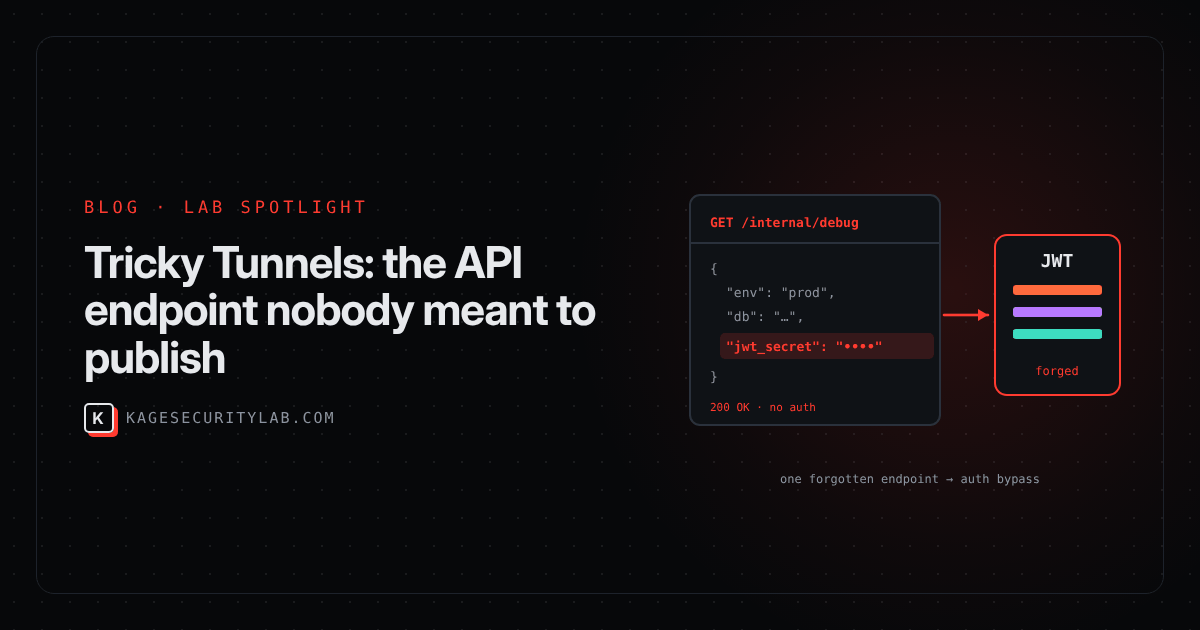
Tricky Tunnels on WebVerse Pro is an API lab, and its lesson is uncomfortable because it is so ordinary: no exotic bug, just an endpoint that was meant for developers and ended up reachable by everyone. It is one of the findings we report most often in API assessments.
What the lab teaches
Without spoiling the path, the lab exercises four skills:
- API discovery: finding endpoints that are not in any menu or documentation, and reading what responses give away.
- Spotting misconfiguration: recognising an internal or debug feature that has no authentication, IP restriction or rate limit.
- Judging data exposure: seeing that configuration returned to an anonymous user can include secrets.
- Understanding impact: a leaked token-signing secret lets anyone create valid tokens, which means bypassing authentication entirely.
The reviewer we credit below rated the difficulty as accurate and liked that an official solution is unlocked after you finish, so you can compare your route with the intended one.
The defender checklist
The same mistake in a real API is cheap to prevent and expensive to miss:
- Inventory your routes. Generate the list of exposed endpoints from the framework or gateway, not from documentation, and review it at every release.
- No debug in production. Debug, health-detail, metrics and admin routes are off in production builds, or bound to an internal interface.
- Authenticate internal endpoints anyway. "Only reachable internally" stops being true the first time a proxy or ingress rule changes.
- Never return secrets. Configuration responses should be allow-listed fields, never a dump of the environment.
- Make a leaked key less fatal. Sign tokens with an asymmetric algorithm (RS256, ES256 or EdDSA), so the service that verifies tokens never holds the key that creates them. Keep signing keys in a secrets manager and rotate them.
- Rotate on suspicion. If a signing secret may have been exposed, rotate it, which invalidates every token signed with it, and review recent sessions.
- Detect forged tokens. Alert on tokens with unknown key IDs, impossible issue times, or privileged claims for accounts that never received them.
How we test for it
In client API assessments we enumerate routes from JavaScript bundles, mobile apps, API schemas and wordlists, then check each one for missing authentication and over-sharing responses. Debug and internal endpoints are among the first things we look for, because they are among the most common critical findings.
Want your APIs checked the same way? See our penetration testing service or talk to an analyst.
Credits and references
- WebVerse Pro: the Tricky Tunnels lab
- Simon McCabe: Tricky Tunnels write-up (the author notes he received free Pro access in exchange for feedback)
- WebVerse Learn: JWT Attacks and other guides